

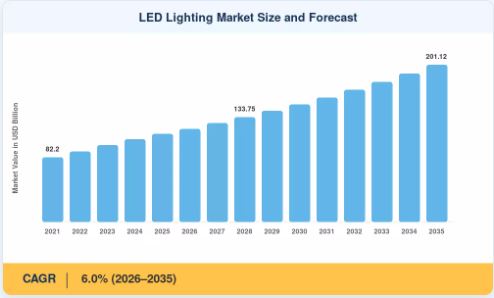
LED Lighting Market Size Expected to Grow from USD 112.30 Billion in 2025 to USD 201.12 Billion by 2035
LED Lighting Market
LED Lighting Market Size, Share and Research Report By Installation Type (New Installation, Retrofit), By Product Type (Lamps, Luminaries)
LED Lighting Market is witnessing robust growth, driven by rising demand for energy-efficient lighting solutions, smart city initiatives, and sustainable infrastructure development.”
TAIPEI, TAIPEI, TAIWAN, August 3, 2026 /EINPresswire.com/ -- The Global LED Lighting market was estimated at USD 112.30 billion in 2025 and is projected to grow from USD 119.04 billion in 2026 to USD 201.12 billion by 2035, registering a CAGR of 6.0% during the forecast period. The market is currently experiencing a transformative phase characterized by rapid technological advancements and increasing consumer awareness regarding energy efficiency, with rising adoption of LED light solutions across residential, commercial, and industrial sectors accelerating demand. As sustainability becomes a focal point for both consumers and businesses, growing recognition of the environmental benefits associated with LED technology longer lifespans and reduced energy consumption compared to traditional lighting continues to widen the addressable market.— Market Research Future (MRFR)
The integration of smart technologies into LED lighting systems is enhancing product appeal, allowing for greater remote control and customization across applications, and in 2025 it is estimated that smart LED lighting will represent over 30% of the total LED market. Regulatory frameworks are evolving in parallel to support the adoption of energy-efficient lighting: in 2025, it is projected that over 80% of new lighting installations will utilize LED technology, driven by policies that phase out incandescent and fluorescent alternatives.
North America remains the largest market for LED lighting at approximately 40% share, driven by increasing energy-efficiency regulations such as the Energy Policy Act, while Europe holds the second-largest share at roughly 30%, propelled by the EU's Ecodesign Directive. Asia-Pacific is the fastest-growing region at approximately 25% share, reflecting a surge in urbanization and infrastructure development across China, Japan, and India, while the Middle East and Africa region, though smaller at around 5% share, is seeing steady growth from infrastructure investment and smart-city initiatives. Vehicle electrification is also boosting demand within the automotive LED lighting segment.
Get Full PDF Sample Copy of Report: (Including Full TOC, List of Tables & Figures, Chart) @
https://www.marketresearchfuture.com/sample_request/2860
➤ How Significant Is the LED Lighting Market's Growth?
The LED lighting market's trajectory from USD 119.04 billion in 2026 to a projected USD 201.12 billion by 2035 represents nearly a three-fold expansion over the forecast decade, reflecting the near-complete displacement of incandescent and fluorescent technologies as regulatory mandates and consumer economics converge in favor of solid-state lighting. The market's 6.0% CAGR is anchored in cost-effectiveness and energy-efficiency dynamics that make LED adoption a financially rational decision for both households and enterprises, not merely an environmentally conscious one.
Residential Lighting leads the application segment, benefiting from established consumer demand and the transition toward smarter, more sustainable homes, while Commercial Lighting is the fastest-growing application segment as businesses invest in LED technology to cut operational costs and meet efficiency targets. By end use, Retail commands the largest share as LED lighting enhances product visibility and shopper experience, while Hospitality is the fastest-growing end-use segment on the back of rising guest expectations for ambiance and energy efficiency. Smart Lighting holds the largest technology share, driven by IoT integration and consumer demand for automation, while LED Downlights are the fastest-growing technology category. By form factor, Bulbs remain the dominant choice for their versatility and ease of installation, while Fixtures are the fastest-growing form factor as new construction and renovation trends favor integrated lighting solutions.
➤ What Does the Future Hold for the LED Lighting Market?
Cost-effectiveness remains a crucial driver for the LED lighting market. While the initial investment in LED technology may exceed that of traditional lighting options, long-term savings on energy bills and maintenance costs are substantial LEDs have a lifespan of up to 25,000 hours, significantly reducing replacement frequency. In 2025, the total cost of ownership for LED lighting is expected to be 50% lower than that of conventional lighting solutions, a financial advantage that is particularly appealing to commercial entities closely monitoring operational costs.
Energy efficiency demand is a second major driver: LEDs consume up to 75% less energy than traditional incandescent bulbs, lowering utility bills while contributing to reduced greenhouse gas emissions, and the energy-efficient lighting segment already accounted for approximately 60% of the overall lighting market in 2023. Environmental regulations are reinforcing this trend, as governments worldwide implement policies phasing out incandescent bulbs in favor of energy-efficient alternatives, with over 80% of new lighting installations expected to utilize LED technology in 2025. Technological innovations including smart lighting systems that integrate IoT capabilities and tunable white LEDs that adjust color temperature based on time of day are further broadening the market's appeal, with smart LED lighting estimated to represent over 30% of the total LED market in 2025.
Consumer awareness and preferences continue to shift decisively toward LED solutions: surveys indicate that over 70% of consumers now prefer LED lighting due to its longevity and reduced environmental impact, a trend increasingly reflected in both residential purchases and commercial procurement decisions. New opportunities are opening in the expansion of smart lighting solutions for urban infrastructure, the development of energy-efficient LED products for industrial applications, and partnerships with renewable energy firms for integrated lighting solutions positioning the market for substantial growth and cementing its role as a leader in sustainable lighting by 2035.
Get access to the full description of the report @
https://www.marketresearchfuture.com/reports/led-lighting-market-2860
➤ Who Are the Key Players in the LED Lighting Market?
The LED lighting market is moderately fragmented, with several key players exerting influence over various segments while niche players continue to thrive alongside larger companies consolidating their positions through strategic partnerships and acquisitions. Competitive differentiation is increasingly shaped by digitalization, sustainability, and the integration of artificial intelligence rather than price alone. MRFR identifies the following key participants:
Philips (NL) - focuses on innovation in smart lighting solutions, leveraging its broad consumer and professional lighting portfolio to maintain a strong market presence.
Osram (DE) - emphasizes its commitment to sustainability through eco-friendly products, anchoring Germany's position as a leading European LED lighting market.
Cree (US) - is known for cutting-edge LED technology that enhances energy efficiency and performance, reinforcing its position among the top players driving North American innovation.
GE Lighting (US) - contributes to North America's competitive landscape through a long-established brand presence across residential and commercial lighting categories.
Signify (NL) - announced a partnership with a leading technology firm to develop advanced smart lighting systems that integrate seamlessly with IoT devices, underscoring its commitment to innovation and positioning it favorably in the growing smart-home market.
Acuity Brands (US) - launched a new line of energy-efficient LED fixtures designed specifically for commercial applications, reflecting its focus on meeting the evolving needs of cost-conscious businesses.
Samsung (KR) - expanded its LED lighting portfolio by introducing a series of customizable lighting solutions aimed at the residential sector, aligning with growing consumer demand for personalized lighting experiences.
LG Electronics (KR) - expands its operations across Asia-Pacific, complementing Samsung's regional presence and reinforcing South Korea's role in the global LED lighting supply chain.
Zumtobel Group (AT) - is making significant inroads in the Middle East and Africa region, supporting the market's competitive landscape of local and international players in emerging territories.
Strategic competition in the LED lighting market is increasingly defined by localized manufacturing and supply-chain optimization, depth of smart-lighting and IoT integration, sustainability credentials, and the pace at which vendors can shift competitive differentiation from price toward technological innovation and supply-chain reliability.
➤ What Are the Emerging Trends in the LED Lighting Market?
Several transformational trends are redefining the LED lighting market's evolution through 2035:
Smart Lighting and IoT Integration: Smart systems are increasing the value proposition of LED light solutions, enabling users to control lighting remotely, adjust brightness, and change colors with smart LED lighting expected to represent over 30% of the total LED market in 2025.
Sustainability-Driven Adoption: Growing emphasis on environmentally friendly solutions is driving demand for energy-efficient lighting options that reduce carbon footprints, strengthening structured LED lighting business models across residential and commercial channels.
Regulatory-Led Market Expansion: Government policies phasing out less efficient lighting technologies are creating a favorable operating environment for LED producers, with over 80% of new lighting installations projected to utilize LED technology in 2025.
Tunable White and Adaptive Lighting: The introduction of tunable white LEDs that adjust color temperature based on time of day represents a notable technological development, appealing to both residential and commercial sectors seeking enhanced user experience.
Urban Infrastructure and Industrial Expansion: New opportunities are emerging in the expansion of smart lighting solutions for urban infrastructure and the development of energy-efficient LED products tailored specifically for industrial applications.
Renewable Energy Partnerships: Partnerships between LED lighting manufacturers and renewable energy firms are creating integrated lighting solutions, particularly relevant for solar-powered outdoor and off-grid applications.
Buy Full Research Report:
https://www.marketresearchfuture.com/checkout?currency=one_user-USD&report_id=2860
➤ How Is the LED Lighting Market Segmented?
The LED lighting market report provides a comprehensive segmentation framework:
By Product Type: Lamps, Luminaries
By Installation Type: New Installation (dominant segment), Retrofit (rapid growth on rising consumer awareness)
By Distribution Channel: Store Based, Non-Store Based
By End-Use Application: Indoor Lighting, Outdoor Lighting
By Application (Market Insight View): Residential Lighting (largest), Commercial Lighting (fastest-growing), Industrial Lighting (emerging), Outdoor Lighting, Architectural Lighting
By Technology: Smart Lighting (largest), LED Downlights (fastest-growing), Incandescent Replacement, Solar Powered Lighting, LED Tubes
By Form Factor: Bulbs (largest), Fixtures (fastest-growing), Strips, Panels, Lamps
By Region: North America (~40% share), Europe (~30% share), Asia-Pacific (~25% share), Middle East & Africa (~5% share)
➤ What Are the Regional Insights from the LED Lighting Market?
North America remains the largest market for LED lighting, holding approximately 40% share, driven by increasing energy-efficiency regulations and a shift toward sustainable lighting solutions. The United States leads the region, followed by Canada at around 15% regional share, with regulatory initiatives such as the Energy Policy Act catalyzing the transition toward energy-efficient technologies. The competitive landscape is dominated by key players like Philips, Cree, and GE Lighting, which are investing heavily in R&D, while the U.S. market is characterized by strong demand for smart lighting solutions across both commercial and residential sectors a focus expected to intensify as energy costs continue to rise.
Europe holds the second-largest market share at approximately 30%, driven by stringent regulations aimed at reducing carbon emissions and promoting energy efficiency. Germany and the UK lead the way, with the European Union's Ecodesign Directive mandating energy-efficient lighting solutions and fostering a favorable environment for LED adoption across sectors. Leading countries including Germany, France, and the UK are witnessing surging demand for innovative lighting solutions, with key players such as Osram and Signify at the forefront, and the competitive landscape is marked by a focus on sustainability and smart technologies that integrate IoT capabilities.
Asia-Pacific is rapidly becoming a powerhouse in the LED lighting market, holding approximately 25% share and fueled by urbanization, industrial growth, and government initiatives promoting energy efficiency. China is the largest contributor within the region, followed by Japan and India, with policies such as China's 13th Five-Year Plan emphasizing the transition to energy-efficient lighting solutions. China's dominance is complemented by a growing presence of international players like Samsung and LG Electronics expanding their regional operations, and as urbanization continues, demand for LED lighting in commercial and residential sectors is expected to soar further.
The Middle East and Africa region is witnessing gradual but steady growth, holding approximately 5% share, driven by increasing investments in infrastructure and energy-efficiency initiatives. The UAE and South Africa lead the charge, with government programs aimed at reducing energy consumption catalyzing the shift toward LED technology, particularly in urban development projects. The UAE is investing heavily in smart-city initiatives, creating a favorable environment for LED adoption, and the competitive landscape features both local and international players, including Zumtobel Group, making significant inroads as the region continues to develop.
➤➤➤ Regional & Country-Level Reports by Market Research Future:
Europe LED Lighting Market -
https://www.marketresearchfuture.com/reports/europe-led-lighting-market-43872
Spain Led Lighting Market -
https://www.marketresearchfuture.com/reports/spain-led-lighting-market-43920
Japan LED Lighting Market -
https://www.marketresearchfuture.com/reports/japan-led-lighting-market-43885
France LED Lighting Market -
https://www.marketresearchfuture.com/reports/france-led-lighting-market-43883
➤➤➤ Related Reports by Market Research Future:
Magnetic Safety Switches Market
https://www.marketresearchfuture.com/reports/magnetic-safety-switches-market-19229
Us Graphics Processing Unit Market
https://www.marketresearchfuture.com/reports/us-graphics-processing-unit-market-21206
Smart Mining Market
https://www.marketresearchfuture.com/reports/smart-mining-market-12026
Motorcycle Insurance Market
https://www.marketresearchfuture.com/reports/motorcycle-insurance-market-10016
Investment Banking Market
https://www.marketresearchfuture.com/reports/investment-banking-market-11815
Pet Insurance Market
https://www.marketresearchfuture.com/reports/pet-insurance-market-12399
Accelerometer Sensor Market
https://www.marketresearchfuture.com/reports/accelerometer-sensor-market-35549
Accidental Death Insurance Market
https://www.marketresearchfuture.com/reports/accidental-death-insurance-market-23901
Ammeter Market
https://www.marketresearchfuture.com/reports/ammeter-market-35542
Audio Codec Market
https://www.marketresearchfuture.com/reports/audio-codec-market-32761
Sagar Kadam
Market Research Future
+ +1 628-258-0071
email us here
Legal Disclaimer:
EIN Presswire provides this news content "as is" without warranty of any kind. We do not accept any responsibility or liability for the accuracy, content, images, videos, licenses, completeness, legality, or reliability of the information contained in this article. If you have any complaints or copyright issues related to this article, kindly contact the author above.
